
The Complete Guide to SWOT Analysis in 2026
MOGHQ — Operational Intelligence Series
Last updated: May 2026 Reading time: 14 minutes Best for: Founders, ops leaders, strategy consultants, and anyone who needs to make a strategic decision with incomplete information.
What Is a SWOT Analysis?
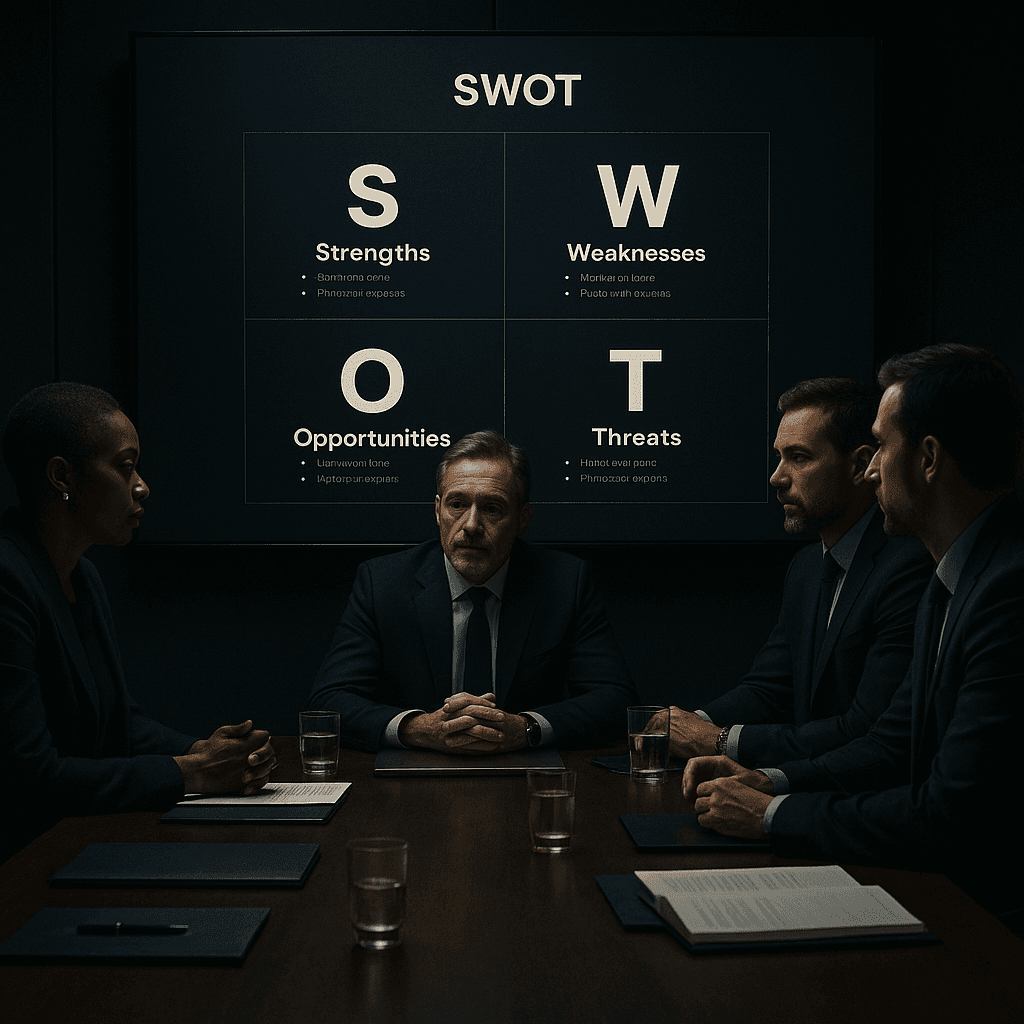
A SWOT analysis is a strategic planning framework that forces you to confront reality — honestly. It divides every factor affecting your business into four categories:
| Helpful | Harmful | |
|---|---|---|
| Internal | Strengths | Weaknesses |
| External | Opportunities | Threats |
That's it. Four boxes. The framework is simple. The execution is hard.
Most SWOT analyses fail not because the framework is broken, but because the people running them are honest with themselves about only three of the four categories. Everyone lists their strengths. Almost no one lists their real weaknesses — the ones that would get someone fired if they showed up in a board meeting.
This guide is different. We'll cover how to run a SWOT that actually informs decisions, not one that validates the narrative you already believe.
The Four Quadrants Explained
Strengths — Internal, Helpful
What does your organization do better than anyone else?
These are your competitive advantages. They can be:
- Tangible: Proprietary technology, exclusive supplier relationships, prime location, capital reserves
- Intangible: Brand reputation, institutional knowledge, company culture, talent density
Be specific. "Good customer service" is not a strength — it's an aspiration. "NPS of 72 in a category where the average is 31" is a strength.
Examples:
- "We hold 3 patents on our core scheduling algorithm"
- "Our average account tenure is 7.2 years vs. industry average of 3.1 years"
- "We have the only dedicated federal contracts team in our metro area"
Weaknesses — Internal, Harmful
What would a well-informed competitor or acquirer list as your vulnerabilities?
This is where most SWOT exercises collapse. The facilitator asks "what are your weaknesses?" and the room goes quiet. Then someone says "we could always improve our social media presence."
That's not a weakness. That's a gap. A weakness is:
- Revenue concentration in a single client (32% of ARR)
- No documented succession plan for the CEO role
- Technical debt that's adding 6 weeks to every feature release
- A leadership team with zero operational experience outside this company
Write them down. They're not a death sentence — they're the starting point of your action plan.
Opportunities — External, Helpful
What trends, market shifts, or regulatory changes are creating openings you could exploit?
Opportunities are external. You can't manufacture them, but you can position yourself to take advantage of them. Common sources:
- Technological shifts: AI capabilities creating new service categories, mobile adoption opening new channels
- Regulatory changes: New compliance requirements that are too expensive for smaller competitors
- Market movements: Adjacent competitors merging, creating gaps in coverage
- Consumer behavior shifts: Remote work normalizing B2B purchasing decisions that previously required in-person relationships
The test for a real opportunity: Can you name a specific capability you'd need to build or acquire to capture it? If not, it's a hope, not an opportunity.
Threats — External, Harmful
What external forces could erode your market position, shrink your margins, or make your current strategy obsolete?
Threats are already happening or highly likely to happen. They are not theoretical:
- "A well-funded competitor just closed a Series B and is expanding into our region"
- "Our primary supplier has indicated pricing will increase 22% next quarter"
- "The labor market in our metro has tightened 18% year-over-year, making our expansion plan harder to execute"
- "Proposed legislation would require us to fundamentally change our data handling practices"
How to Run a SWOT Analysis That Produces Real Output
Most SWOT workshops produce a four-quadrant diagram that gets photographed, shared in Slack, and never looked at again.
Here's how to run one that actually drives decisions:
Step 1: Define the Scope Before You Start
A SWOT without a scope is a brainstorming session with extra steps. Before anyone opens a sticky note, agree on:
- The decision being made — "Should we enter the healthcare vertical?"
- The time horizon — "12 months" or "3 years" produces very different outputs
- Who is in the room — and critically, who is NOT in the room but has relevant information
Step 2: Run Weaknesses and Threats First
Most people start with strengths. Do the opposite. Starting with strengths anchors the conversation around what you already have, which biases you against opportunities that require building new capabilities.
Start with weaknesses. Get the uncomfortable things on the table while the group is fresh and willing to be honest. Then move to threats — external forces that are already moving against you.
This order produces better output and surfaces harder truths.
Step 3: Use a 2×2 Matrix, Not a Bulleted List
A bulleted list of 15 strengths tells you nothing about priorities. A 2×2 matrix — where you rate each factor by impact (high/low) and likelihood (high/low) — forces you to make decisions.
Your final output should look like this:
                    HIGH IMPACT           LOW IMPACT
                ┌────────────────────┬────────────────────┐
    HIGH        │   PRIORITY NOW     │   MONITOR          │
    LIKELIHOOD  │   Weaknesses to fix │   Threats to watch │
                │   Opportunities to │                     │
                │   capitalize on    │                     │
                ├────────────────────┼────────────────────┤
    LOW         │   BUILD CAPABILITY  │   ACCEPT & MOVE ON │
    LIKELIHOOD  │   (if resources    │   (low probability │
                │    allow)          │    or impact)      │
                └────────────────────┴────────────────────┘
Step 4: Assign Owners and Deadlines
A SWOT without owners is a document. A SWOT with owners is a management system.
Every high-impact item should have:
- A named owner (not a team, not a department — a person)
- A target completion date
- A definition of done
Step 5: Cross-Reference with TOWS
The TOWS matrix transforms your SWOT into actionable strategies by cross-referencing the quadrants:
| Strengths | Weaknesses | |
|---|---|---|
| Opportunities | SO Strategies — Use strengths to capture opportunities | WO Strategies — Use opportunities to overcome weaknesses |
| Threats | ST Strategies — Use strengths to defend against threats | WT Strategies — Minimize weaknesses, avoid threats |
We cover TOWS in depth in our separate guide. [Link to TOWS article]
Common SWOT Analysis Mistakes
Mistake 1: Listing Aspirations as Strengths
"We have a strong commitment to customer excellence."
No. That's a value statement, not a strength. A strength is something a competitor cannot easily replicate. Write the number.
Mistake 2: Confusing Internal and External Factors
Your vendor dependencies are internal (Weaknesses). A new competitor entering your market is external (Threats). If you can't control it, it's external.
Mistake 3: Doing It Alone
A solo SWOT is just your biases on a page. Bring in people with different functional perspectives — sales sees things operations doesn't, finance sees things sales doesn't. Conflict in the room is the point.
Mistake 4: Treating It as a One-Time Exercise
Markets change. A SWOT done 18 months ago and never updated is not a strategic document — it's a relic. Schedule annual reviews, or run a new one whenever a major strategic decision is on the table.
Mistake 5: Skipping the TOWS Cross-Reference
The quadrants by themselves describe where you are. The TOWS matrix tells you what to do about it. Skipping TOWS is like getting a medical diagnosis and then not asking the doctor what to do next.
How AI is Changing SWOT Analysis
Traditional SWOT is manual, slow, and limited by the knowledge of the people in the room. AI-assisted SWOT analysis changes the equation in three ways:
1. Competitive Intelligence at Scale
Running a SWOT on "should we enter the healthcare market?" requires knowing what existing players are doing, what their margins are, what their customers are saying about them, and what their recent moves signal. That research used to take a consultant team two weeks. AI can synthesize that data in minutes — leaving human judgment for the interpretation, not the data collection.
2. Unfiltered Honest Assessment
People in SWOT workshops tend to cluster around social desirability — they don't want to be the person who says "our product is three years behind the market" in front of the person who built it. AI doesn't have that problem. It will tell you the gap exists, even if no one in the room will.
3. Dynamic Scenario Modeling
A static SWOT gives you a snapshot. AI-assisted SWOT can model how the matrix shifts under different assumptions — "if this competitor merges with that one, what happens to our Opportunities quadrant?" That's strategic agility that a sticky-note workshop simply cannot provide.
MOGHQ's Execution Strategy Report uses AI to run your SWOT inputs through deep competitive research and generate a TOWS-driven action plan. [Link to product]
When to Use SWOT (and When Not To)
SWOT is the right tool when:
- You're entering a new market or launching a new product
- You're preparing for a major competitive threat
- You're aligning a leadership team on strategic priorities
- You're structuring a business plan for an investor or lender
SWOT is the wrong tool when:
- You need financial projections (use a financial model)
- You need process improvement (use lean or Six Sigma)
- You need creative ideation (use a different brainstorming framework first)
- You're trying to diagnose an operational problem (root cause analysis is more appropriate)
The SWOT Analysis Template
Before you start, here's the framework. Fill it in honestly, then cross-reference with TOWS before you present it to anyone.
┌─────────────────────────────────┬─────────────────────────────────┐
│ STRENGTHS                       │ WEAKNESSES                      │
│ (Internal, Helpful)              │ (Internal, Harmful)             │
│                                 │                                 │
│ 1.                              │ 1.                              │
│ 2.                              │ 2.                              │
│ 3.                              │ 3.                              │
│ 4.                              │ 4.                              │
│                                 │                                 │
├─────────────────────────────────┼─────────────────────────────────┤
│ OPPORTUNITIES                   │ THREATS                         │
│ (External, Helpful)              │ (External, Harmful)             │
│                                 │                                 │
│ 1.                              │ 1.                              │
│ 2.                              │ 2.                              │
│ 3.                              │ 3.                              │
│ 4.                              │ 4.                              │
│                                 │                                 │
└─────────────────────────────────┴─────────────────────────────────┘
[Download free SWOT Template — PDF]
What's Next
A SWOT analysis is a starting point, not a destination. Once you've completed yours:
- Prioritize using the 2×2 impact/likelihood matrix
- Cross-reference with TOWS to generate strategies
- Build a 90-day action plan from the top-priority items
- Assign owners and schedule a review in 90 days
If you want an AI-assisted SWOT — where your inputs are analyzed against real competitive data and delivered with a TOWS matrix and a 3-month execution blueprint — [run your MOGHQ Execution Strategy Report.]
This article is part of MOGHQ's Operational Intelligence Series. For related reading, see: [TOWS Analysis: The SWOT Matrix That Actually Drives Strategy] and [Why 90% of Strategies Fail at Execution].