
TOWS Analysis: The SWOT Matrix That Actually Drives Strategy
MOGHQ — Operational Intelligence Series
Last updated: May 2026 Reading time: 9 minutes Prerequisite: Read [The Complete Guide to SWOT Analysis in 2026] first.
The Problem with SWOT Alone
A finished SWOT analysis looks authoritative. Four quadrants, clean fonts, maybe a nice graphic in the board deck. And then nothing happens.
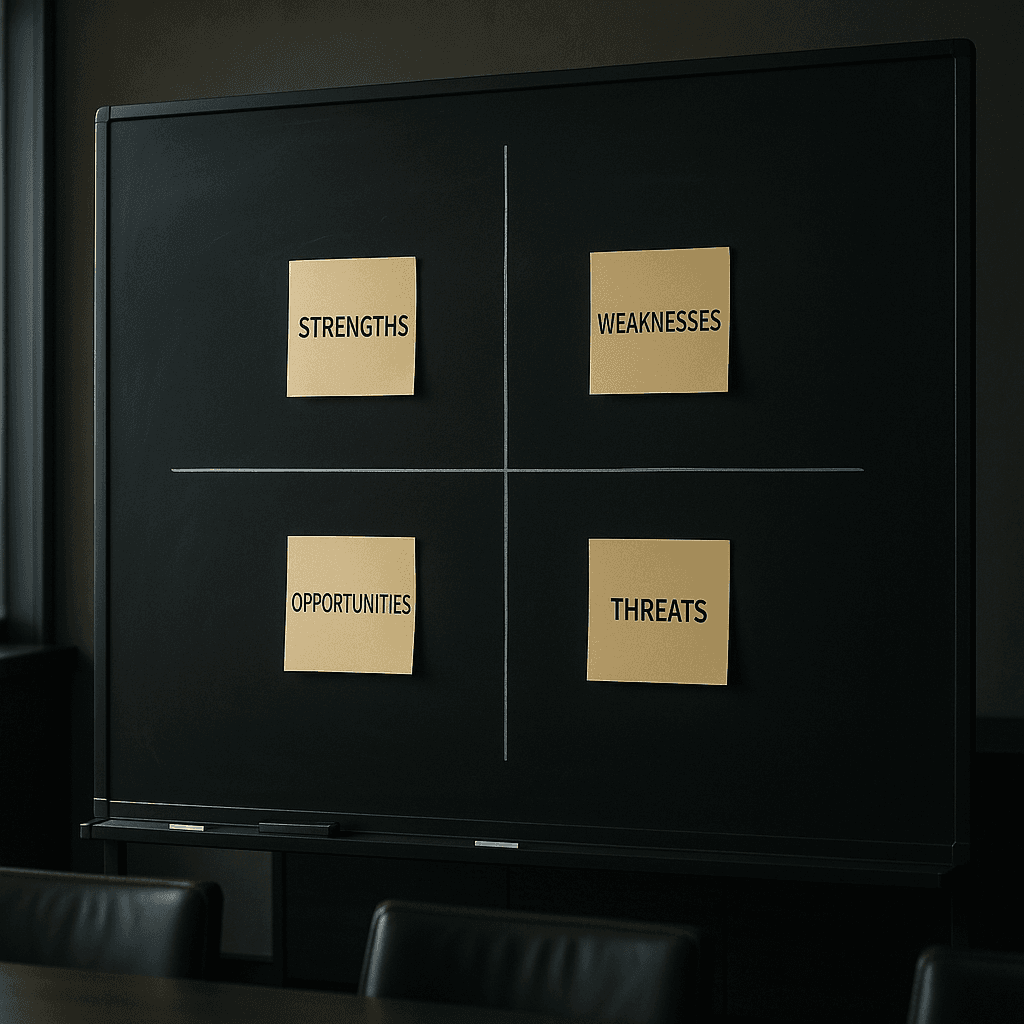
The SWOT framework tells you where you are. It does not tell you what to do about it. That gap — from analysis to action — is where most strategic planning fails.
The TOWS matrix closes that gap.
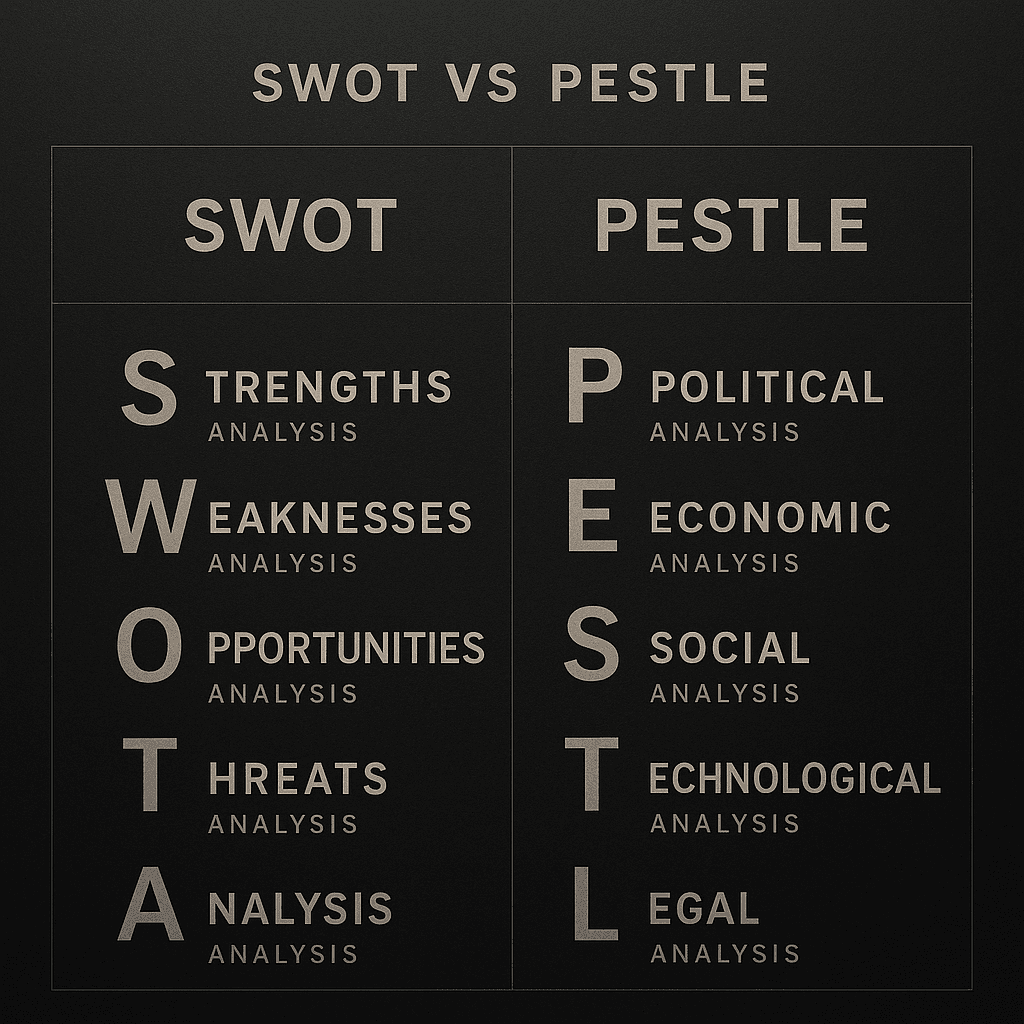
TOWS stands for Threats, Opportunities, Weaknesses, Strengths. It's a tool developed by business strategy academic Heinz Weihrich in 1982, and it remains one of the most underused strategic planning tools in existence. It works by systematically cross-referencing your internal factors (Strengths and Weaknesses) with your external factors (Opportunities and Threats) to generate specific, actionable strategies.
The Four TOWS Quadrants
SO Strategies — Strengths + Opportunities
Use your strengths to capture opportunities.
This is the optimistic quadrant — you're matching what you're good at with what's available. But don't mistake optimism for strategy. The question isn't just "can we do this?" but "should we, given our strengths?"
Examples:
- "Our strengths: proprietary supply chain technology, 23-person sales force. Opportunity: a new regulatory category creating demand for our exact capability. SO Strategy: Build a dedicated compliance track within our product line and activate the sales force for a 90-day sprint." [Link to product]
- "Our strengths: strong regional brand, loyal customer base. Opportunity: a national competitor is entering our geography. SO Strategy: Launch a customer loyalty program before their brand awareness campaign launches."
The test: Is this opportunity a better fit for your strengths than for your competitors'? If any company could capture it, it's not an SO strategy — it's just an opportunity.
ST Strategies — Strengths + Threats
Use your strengths to neutralize or defend against threats.
Examples:
- "Our strength: market-leading NPS (72). Threat: a new competitor with VC backing launching a price war. ST Strategy: Double down on service quality — make switching feel too risky for our most profitable customers."
- "Our strength: proprietary data set covering 15 years of industry trends. Threat: proposed legislation would require us to make this data public. ST Strategy: Use the remaining window to build a consulting practice around the data before the regulation takes effect."
The test: Is there a specific strength that gives us an asymmetric advantage against this threat? If the threat would hurt our competitors too, it's not an ST strategy — it's just a threat.
WO Strategies — Weaknesses + Opportunities
Use opportunities to build capabilities that address your weaknesses.
This is the hardest quadrant for most organizations, because it requires admitting that you're not currently well-positioned to do something — and then building toward it anyway.
Examples:
- "Our weakness: no digital product, no recurring revenue model. Opportunity: SaaS adoption in our category is growing 34% annually. WO Strategy: Acquire a small SaaS competitor to buy the recurring revenue model and engineering talent, then integrate our domain expertise into their product."
- "Our weakness: leadership team has no M&A experience. Opportunity: a strategic acquisition target is available at a reasonable valuation. WO Strategy: Engage an investment bank as an advisor and structure the deal with an earnout to mitigate integration risk."
The test: Can we realistically close this weakness gap before the opportunity closes? An 18-month capability build against a 6-month window is not a strategy — it's a hope.
WT Strategies — Weaknesses + Threats
Minimize your weaknesses and avoid the threats that exploit them.
This is the defensive quadrant. The goal is survival, not growth. Organizations that skip this quadrant are often the ones that get caught off-guard.
Examples:
- "Our weakness: 64% of revenue is from one client whose contract expires in 14 months. Threat: the client has signaled they're exploring alternatives. WT Strategy: Immediately initiate a structured diversification plan. No new major initiative that doesn't have a path to revenue in under 12 months."
- "Our weakness: aging technology stack requiring expensive maintenance. Threat: a cyber attack on our infrastructure would expose sensitive customer data. WT Strategy: Initiate an emergency security audit, prioritize remediation of critical vulnerabilities, and begin planning the platform migration."
The test: Are we trying to be everything, or are we being honest about what we should exit? WT thinking sometimes leads to the strategic decision to stop doing something entirely. That's still a strategy.
How to Build a TOWS Matrix
Step 1: Start with a Valid SWOT
Don't do TOWS with a fuzzy SWOT. Every item in each quadrant should be specific and verifiable. "Our culture is collaborative" is not a Strength — it's a vibe. "Our customer escalation rate is 0.3% vs. industry average of 2.1%" is a Strength.
Step 2: Build the 2×2 Grid
              STRENGTHS                    WEAKNESSES
           ┌─────────────────┬─────────────────┐
  O        │                 │                 │
PP        │     SO #1       │     WO #1       │
R         │     SO #2       │     WO #2       │
T         │                 │                 │
U         ├─────────────────┼─────────────────┤
N         │                 │                 │
I         │     ST #1       │     WT #1       │
T         │     ST #2       │     WT #2       │
I         │                 │                 │
E         └─────────────────┴─────────────────┘
S
Step 3: Generate Ideas in Each Cell
This is a workshop exercise. For each cell, ask:
- "How could we use [strength] to exploit [opportunity]?"
- "How could we use [strength] to defend against [threat]?"
- "How could [opportunity] help us fix [weakness]?"
- "How could we protect ourselves from [threat] while we address [weakness]?"
Don't filter during the brainstorming phase. Quantity first. Quality comes after.
Step 4: Evaluate and Prioritize
For each generated strategy, assess:
- Resource requirement: High / Medium / Low
- Time to impact: <90 days / 90-180 days / 180+ days
- Risk: High / Medium / Low
- Strategic alignment: Does this fit our core identity and stated priorities?
Step 5: Select 3-5 Priorities and Build an Action Plan
Don't try to execute everything. Pick the three to five strategies that have the highest impact and lowest resource requirement — the "quick wins" — and build a 90-day action plan around them.
TOWS in Practice: A Worked Example
Company: Regional HVAC contractor, 85 employees, $18M ARR.
SWOT Summary:
- Strengths: Market-leading technician retention (avg. 8 years), proprietary job management software, 23-year relationships with major commercial clients
- Weaknesses: No 24/7 service capability, no residential energy efficiency offering, heavy reliance on two commercial clients (48% of revenue)
- Opportunities: Growing demand for smart building management systems, new state legislation requiring energy audits for commercial buildings, residential market underserviced post-pandemic
- Threats: National chain expanding into region with $40M in backing, rising van and equipment costs squeezing margins, technician shortage across the trades
TOWS Strategies Generated:
| Cell | Strategy |
|---|---|
| SO | Leverage 23-year client relationships to become the preferred vendor for smart building retrofits as legislation drives demand |
| SO | Deploy proprietary job management software as a differentiator in the commercial RFP process against the national chain |
| ST | Use technician tenure and relationships as a customer retention weapon — prioritize service quality over price in competitive situations |
| WO | Partner with a smart building hardware vendor to offer 24/7 monitoring services without building the capability in-house |
| WT | Immediately begin diversifying revenue away from the two top clients — set a target of no single client above 25% within 18 months |
| WT | Create a formal succession and recruitment program to address the technician shortage before the national chain's expansion creates a bidding war for talent |
Selected Priority: SO #1 + WT #1 — Use the legislation-driven demand to accelerate smart building offerings while the national chain is still organizing their regional entry.
The TOWS Output Is Only as Good as the SWOT Input
The TOWS matrix is mechanical. Put in a bad SWOT, get out a bad TOWS analysis. The discipline is in the quality of the four quadrants before you start cross-referencing.
Most TOWS workshops fail because they skip from SWOT to strategy without doing the honest work of getting the SWOT right. The SWOT is where you confront reality. TOWS is where you decide what to do about it.
Run them together. In the same session. Same room. With the right people.
Next Steps
- [Download the TOWS Matrix Template]
- [Run your full Execution Strategy Report] — MOGHQ's AI-assisted process generates your SWOT, TOWS matrix, and 3-month action plan in a single report.
- Read: [Why 90% of Strategies Fail at Execution]
- Read: [How to Build a 90-Day Execution Plan]
Part of MOGHQ's Operational Intelligence Series.