How Agentic AI Is Rewriting the Rules of Search Rankings
Published May 28, 2026 · 9 min read
For most of the internet's life, "ranking on Google" meant one thing: stacking your page with the right keywords and hoping enough people clicked through. Those days are over — and the funeral happened quietly, without most business owners noticing.
Google just rolled out the biggest overhaul to its search box in 25 years. The new version doesn't look dramatically different on the surface — same austere input field, now dynamically expanding — but what's happening behind it represents a fundamental shift in how information gets found, ranked, and delivered. This is not a design refresh. This is a structural change to the internet's nervous system.
We covered the basics of this shift in our article Is My Website AI Ready?. But a new layer has arrived — one that changes not just how people search, but who is doing the searching. And that has enormous implications for every business that relies on being found online.
What Is Agentic AI, Anyway?
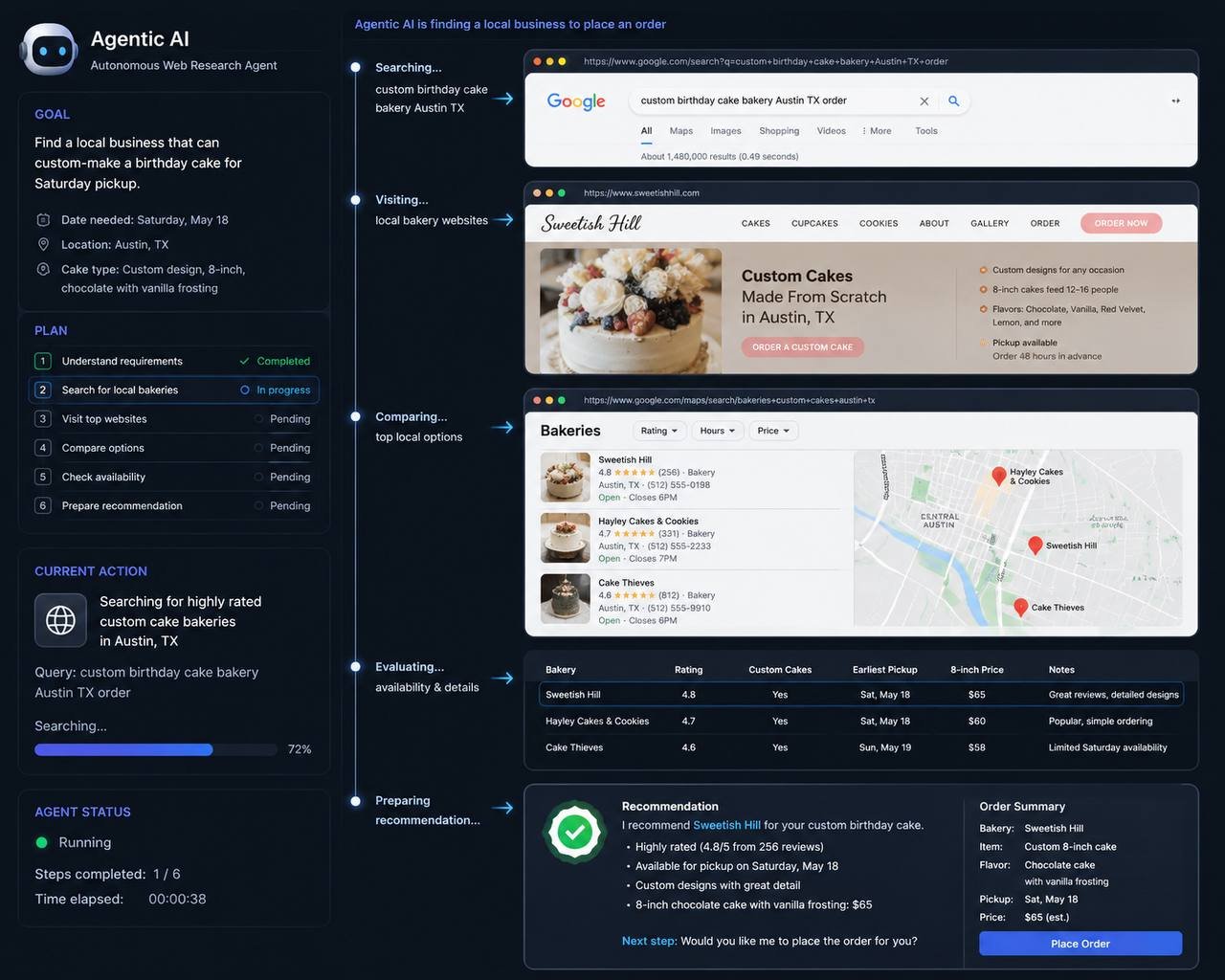
You've probably heard "AI" used to describe chatbots, autocomplete, and image generators. "Agentic AI" is the next step: AI that doesn't just respond to queries — it acts on your behalf.
Think of it this way. Traditional search means you ask a question, Google shows you links, and you do the work. Agentic search means you describe what you want, and Google's AI agents go find it, monitor it, and bring you back exactly what you need — without you lifting a finger.
As NPR reported in May 2026, Google is introducing "information agents" that work in the background 24/7, scanning blogs, news sites, social posts, and real-time data across the web to alert you when something matches your specific question. If you're apartment hunting, you can "brain dump" your requirements and the agent will continuously scan listings and notify you when something fits. If you want to track a competitor's pricing, your agent monitors that indefinitely.
This isn't science fiction. It rolled out globally this week.
The Old Rules: Keywords, Links, and Click-Through Rates
For the past two decades, SEO worked roughly like this:
- Identify what your customers were searching for
- Build pages targeting those keywords
- Earn backlinks to signal authority
- Optimize for click-through rate from the search results page
The entire game was about influencing where your page appeared in a list of blue links. Being #1 or #2 meant traffic. Traffic meant revenue.
Google's AI Overviews — the AI-generated summaries that now appear at the top of most search results — already disrupted this model significantly. Pew Research found that only 8% of users who see an AI Overview click a link in the search results, versus 15% of those who don't. The AI is eating the click economy.
But agentic AI takes this further. When your personal AI agent is doing the searching for you, the question isn't whether your page appears on a results screen. The question is whether your business exists in the knowledge graph the AI is reasoning from.
The New Rules: Citations, Context, and Being "AI-Readable"
Agentic search introduces a new ranking mechanism that has almost nothing to do with traditional SEO:
1. Are you cited as a source?
When an agent researches a question on your behalf, it doesn't just pull from the top 10 results. It synthesizes information across dozens of sources, then surfaces the most relevant facts — citing the sources it used. Being cited by name, with accurate information, in a context the AI considers authoritative — that's the new #1 ranking.
2. Is your information structured and trustworthy?
AI systems are trained to prefer content that is clear, specific, and updated. A page that says "We offer IT services for small businesses" tells an AI almost nothing useful. A page that says "Managed IT support for law firms with 10–50 employees in Chicago, flat-rate pricing starting at $1,200/month" gives the AI something concrete to cite and recommend.
3. Does your brand appear where AI agents are looking?
AI search systems don't just crawl web pages the way Google's index bots always have. They pull from structured data, news feeds, authoritative reference sources, and sites with high E-E-A-T (Experience, Expertise, Authoritativeness, Trustworthiness). If your business isn't present in the channels AI systems trust, you don't exist in the AI search economy.
4. Is your knowledge base consistent across the web?
When an AI agent asks "Who is the best-managed IT provider in Chicago for law firms?", it cross-references what it finds across your website, LinkedIn, business directories, review sites, and news mentions. Inconsistency — conflicting addresses, outdated pricing, vague service descriptions — signals low reliability to an AI, and your ranking suffers.
Why Organic Traffic Is Declining — and What Replaces It
The numbers are sobering. As Google's AI Overviews expanded, referral traffic to websites from search has been in sustained decline. The new agentic features — information agents that monitor and synthesize without requiring clicks, generative UI that builds interactive tools in place — are expected to accelerate this trend significantly.
This is the "Google Zero" scenario that publishers and marketers have been warning about: the point at which Google users get what they need from the AI response itself, without ever visiting the source website. If no one clicks through to your site, your existing traffic-based business model breaks — whether you're running a blog, an e-commerce store, or a service business that depends on inbound leads.
The businesses that will thrive in this environment aren't the ones trying to outrank each other on a results page. They're the ones making themselves indispensable to AI agents as a cited, trusted source.
What This Means for Your Website
The shift from keyword-based search to agentic AI search changes the optimization target entirely. It's no longer "how do I rank #1 in Google." It's "how do I become the business that AI agents recommend."
That means asking different questions:
- Does our website give AI systems enough specific, accurate information to cite us in a recommendation?
- Are we present in the directories, news sources, and reference platforms that AI agents trust?
- Is our brand information consistent across every platform where we appear online?
- Do we have the kind of specific, demonstrable expertise — pricing, case studies, credentials, service details — that an AI can confidently point someone to?
How to Find Out Where You Stand
These aren't rhetorical questions. They're the exact questions that determine whether your business survives the shift to AI search — or gets left behind entirely.
MOGHQ's AI Readiness Assessment evaluates your website against the criteria that agentic AI systems use to decide whether to cite, recommend, or surface your business. It takes under 5 minutes and gives you a clear, actionable report on where you're positioned well and where you're invisible to the AI systems that are increasingly doing your customers' searching for them.
The rules of search have changed. The good news: the new rules are learnable, and the gap between businesses that understand them and those that don't is still wide enough to close with focused effort.
Ready to know where you stand? Take the AI Readiness Assessment →