Is My Website AI Ready? How to Show Up When Customers Search with AI
MOGHQ — Operational Intelligence Series
Last updated: May 2026 Reading time: 9 minutes
If you ran a business in the early 2000s and didn't show up on Google, you were invisible. Customers were searching for what you sold, and if your website wasn't in the results, you didn't exist to them.
That moment is happening again — but the search engine is different, the rules are different, and most business owners don't know it yet.
AI search is replacing the traditional search engine results page. ChatGPT, Perplexity, Google's AI Overviews, and other AI-powered answers are where millions of people now start their buying journeys. And the websites that appear in those results — the ones AI tools recommend, cite, and surface — are not the same ones that ranked #1 on Google five years ago.
This article explains what that means for your business, what "AI ready" actually means for a website, and how to find out where you stand before your competitors figure it out.
What Is AI Search, Exactly?
Traditional search works like an index. Google crawls the web, catalogs pages by keywords and links, and returns a ranked list of links when you type a query. You click a link and leave the search engine to visit the website.
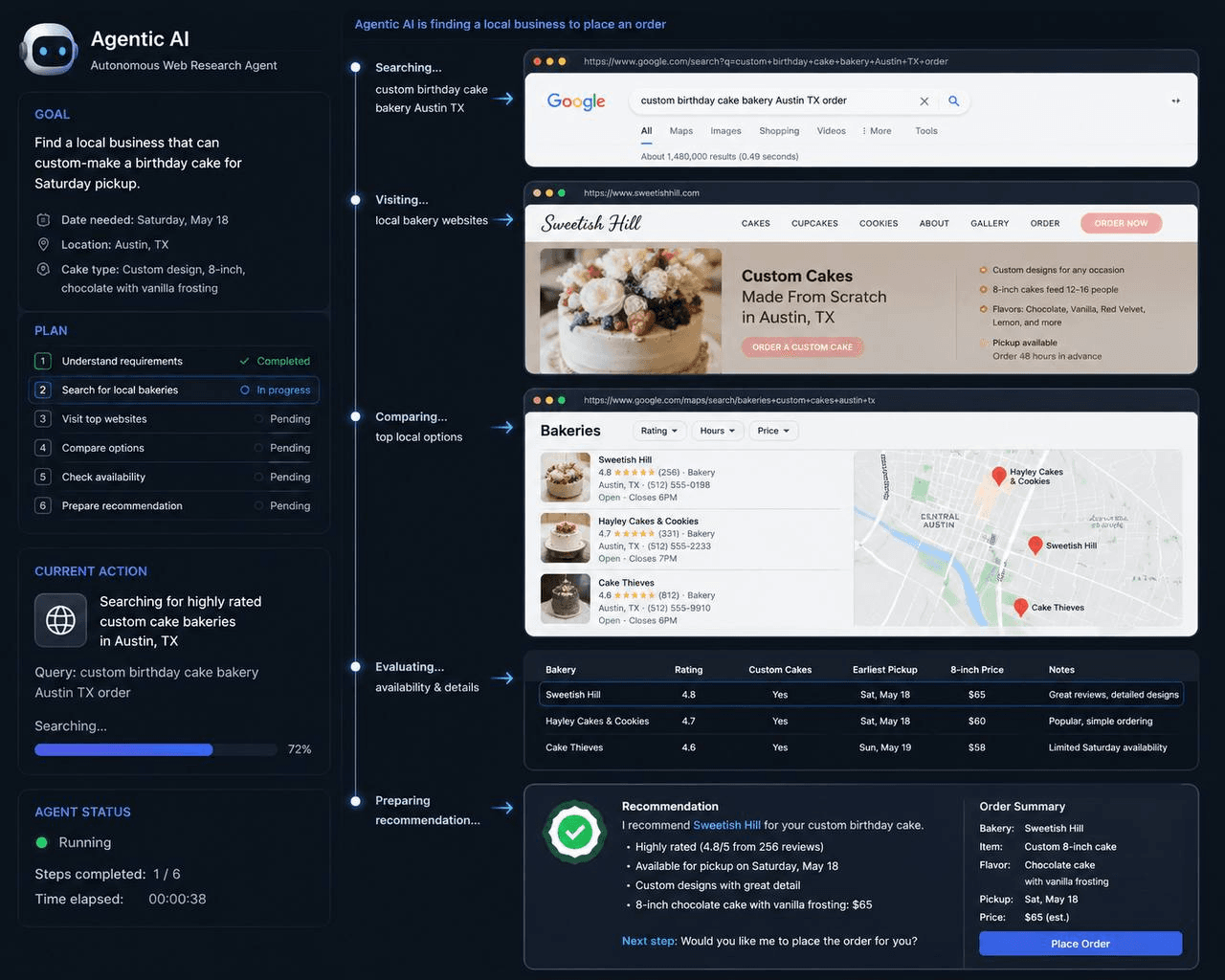
AI search works differently. When you ask ChatGPT or Perplexity a question, the AI generates an answer — and part of that answer may include a direct recommendation for a specific business, product, or service. The AI is drawing from information it found on the web, but it's synthesizing and presenting it in a way that often means the user never needs to click through to a website at all.
This is called AI citation or AI grounding. The AI references specific sources when it gives an answer. Those sources are not random — they're pulled from websites that have structured, clear, and trustworthy content.
The practical implication for your business: if AI systems can't read, understand, and trust your website, you won't appear in the answers they're giving to your potential customers.
Why "Just Having a Website" Is No Longer Enough
Most small business websites were built for two audiences: human visitors and Google's crawler. They were optimized for keywords, load speed, and backlinks — the signals Google used to determine ranking.
AI systems use different signals. They're looking for:
- Clear, structured content that states what you do, who you serve, and what makes you different — in plain language, not just in image alt text and meta tags.
- Schema markup and structured data that helps AI understand what your business is, where you're located, what services you offer, and whether you're trustworthy.
- Authoritative, substantive content — not 300-word pages stuffed with keywords, but real information that demonstrates expertise.
- Technical foundations that don't break AI parsers: proper HTML semantics, canonical tags, clean URLs, and working internal linking.
- Trust signals that AI can evaluate: reviews, citations, references to established sources, and consistent business information across the web.
A website that was "good enough for SEO in 2020" may score poorly on all of these. The good news: these are fixable problems.
The Six Categories of AI Website Readiness
An AI readiness assessment evaluates your website across six dimensions. Here's what each one means for your business:
1. Performance
AI systems — like humans — prefer fast websites. A slow-loading page signals an outdated or neglected website. Core Web Vitals (loading speed, interactivity, visual stability) are a baseline signal of quality that AI systems factor into trust assessments.
What to look for: Your pages loading in under 3 seconds on mobile. Images optimized and compressed. No unnecessary JavaScript blocking rendering.
2. SEO (Traditional)
Ironically, the foundations of traditional SEO still matter — because AI systems train on the same web content that search engines index. Proper title tags, meta descriptions, heading hierarchy, internal linking, and a clean XML sitemap are still prerequisites for AI systems to find and parse your content.
If Google can't properly crawl your site, AI systems can't either.
3. Accessibility
Web accessibility — making your site usable by people with disabilities — overlaps significantly with AI readiness. Screen reader compatibility, proper alt text, sufficient color contrast, and keyboard navigability all help AI parsers understand your content structure.
What to look for: Alt text on all meaningful images. Proper heading hierarchy (H1 → H2 → H3). No orphan pages with no incoming links.
4. Mobile Optimization
Over 60% of web traffic now comes from mobile devices. AI systems deprioritize sites that don't render properly on phones. If your website was built before mobile-first indexing became standard, it's likely scoring below its potential on this dimension.
5. Content Quality
This is where most small business websites lose the most points. Thin content — generic service descriptions, "we are a premier provider of..." language with no specifics, pages with under 300 words — gives AI systems almost nothing to work with when they're deciding whether to recommend you.
AI systems want to see: specific claims, real examples, pricing ranges, service descriptions that include what you actually do and who you actually serve, and proof points (testimonials, case studies, credentials, associations).
6. AI Readiness (Structural)
This is the newest category and the one most directly tied to AI citation. It covers:
- Schema.org structured data — markup that explicitly tells AI systems "this is a local business," "this page is a service page," "this review is a customer testimonial"
- Entity clarity — does your website clearly communicate what specific type of business you are, in terms an AI can categorize and compare?
- Content that answers questions — does your website anticipate and answer the questions your customers actually ask, rather than just describing what you do?
- Citation potential — would an AI finding your website want to cite it as a source? Is the information specific, authoritative, and unique enough to be worth quoting?
How to Find Out If Your Website Is AI Ready
You can audit your own site using these questions:
Performance: Run your homepage through PageSpeed Insights (Google's free tool). Score above 80 on mobile? You're in decent shape. Below 50? This is your most urgent fix.
Content depth: Look at your five most important pages (homepage, main service page, about page, contact page, one specific service page). Count the words on each. If any has fewer than 400 words of actual content, it's too thin for AI systems to extract meaningful information.
Schema markup: Paste your homepage URL into Google's Rich Results Test. Does it return any structured data detected, or "no structured data found"? If the latter, you have a significant gap.
Question-answer content: Do you have a blog or resources section with articles that answer specific questions your customers ask? If your website only has service descriptions and a contact form, there's nothing for AI systems to cite.
Mobile check: Open your website on a phone right now. Is the phone number clickable? Does the menu work? Does everything load without horizontal scrolling? If not, mobile optimization is costing you on multiple dimensions.
For a comprehensive assessment across all six categories, get an AI Website Readiness Report — it scores your site 0–100 across every dimension that AI systems evaluate, with specific findings and prioritized recommendations.
Why Your Competitors Are Probably Not Ahead of You (Yet)
Here's the reality for most small and mid-sized businesses: almost no one is fully "AI ready" yet. The businesses that are actively optimizing for AI search are almost exclusively enterprises with dedicated digital marketing teams and agencies.
The window for small businesses to get ahead of this trend is open right now — and it's closing within the next 12 to 18 months. As more business owners become aware of AI search, the competition for AI citation will intensify the same way SEO competition intensified in the mid-2010s.
The businesses that act now will build the citations, content, and technical foundations that make them the obvious recommendation when AI systems answer queries in their category. The businesses that wait will be starting from scratch while the field is already crowded.
The Question to Ask Yourself Right Now
The single most useful question you can ask about your website's AI readiness is not "does my site rank on Google?"
It's this: if a potential customer asked an AI to recommend a [your service] in [your city], would the AI recommend us?
If the answer is "I don't know," or "probably not," that's exactly what an AI Website Readiness Report is designed to diagnose — and the fixes are usually more straightforward than business owners expect.
Most sites that score poorly on AI readiness aren't beyond saving. They're missing a few specific structural elements, have thin content in a few key places, and lack the schema markup that tells AI systems what they're actually looking at.
Those are fixable problems.
Get Your AI Website Readiness Report
The AI Website Readiness Report from Morefield Operations Group gives you a 0–100 score across all six dimensions that AI systems evaluate — performance, SEO, accessibility, mobile, content quality, and AI structural readiness.
You'll receive a detailed PDF with specific findings and prioritized recommendations. The report takes minutes to request and delivers within 72 hours.
Get your AI Website Readiness Report →
Morefield Operations Group helps small businesses understand their strategic position — including their digital readiness for the AI era. To discuss your business's competitive position, contact us.