
SWOT Analysis for Startups: What Changes When You Have No History
MOGHQ — Operational Intelligence Series
Last updated: May 2026 Reading time: 8 minutes Best for: Founders, early-stage operators, startup advisors
The classic SWOT framework was designed for companies with history. Strengths and weaknesses are built over years — brand equity, customer relationships, institutional knowledge, technical debt. Opportunities and threats are calibrated against an established market position.
Startups have none of that.
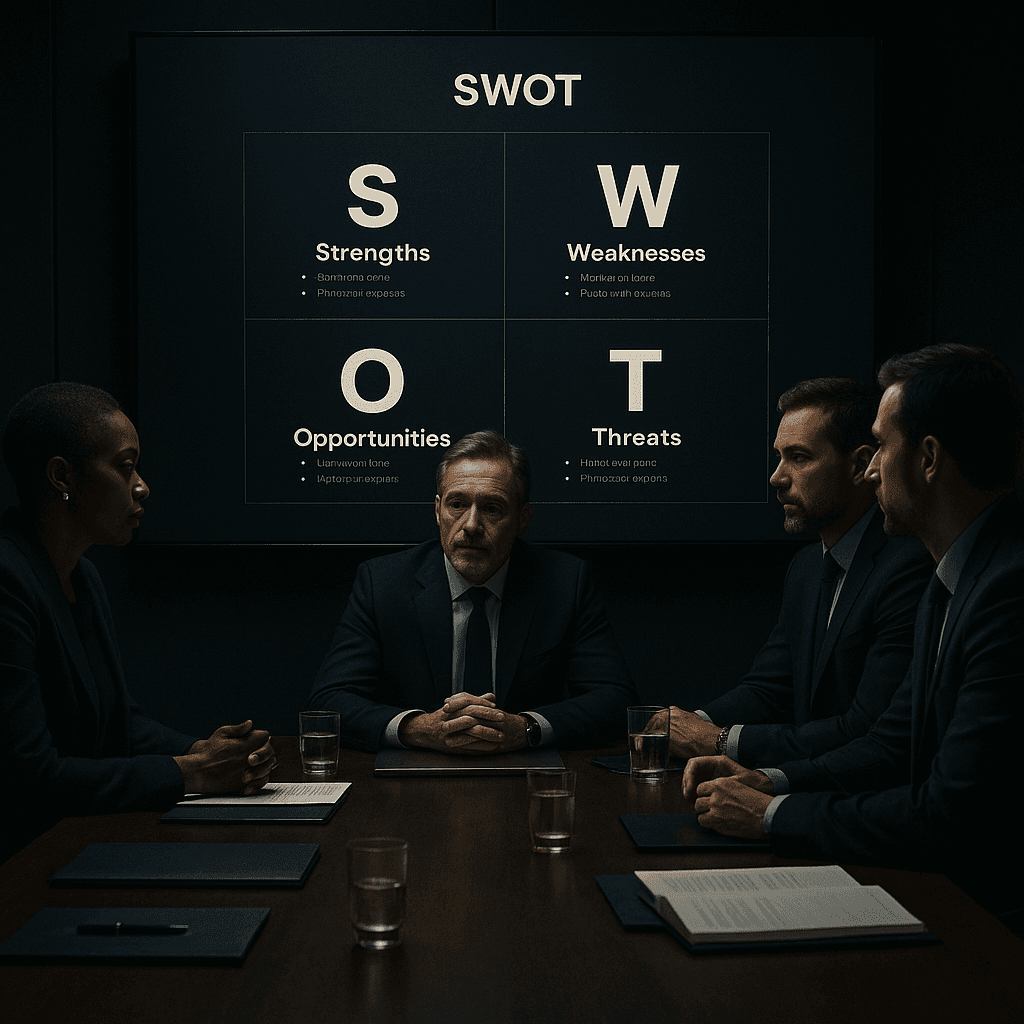
A startup's SWOT looks different not because the framework doesn't apply — it does — but because the content of each quadrant is fundamentally different. This guide is about adapting the framework to the realities of early-stage companies.
What a Startup SWOT Actually Looks Like
Strengths — What You Have (That Won't Last Forever)
Most startup founders list their Strengths as things that are actually Opportunities — "the market is huge," "our technology is revolutionary." These are not strengths. These are external conditions.
A startup's actual strengths are:
- Domain expertise — the founders understand the problem space deeply
- Speed — no legacy systems, no committee approvals, no institutional inertia
- Traction signal — even small revenue or user numbers are a strength when they're growing
- Conviction — founders who have put personal capital on the line are more aligned than most corporate leadership
- Adaptability — the ability to change direction without a board resolution
The critical thing about startup strengths: most of them are temporary. Speed is a strength until you scale. Conviction is a strength until you're raising a Series B and the investors' conviction outweighs yours.
Weaknesses — The Honest List
Startup weaknesses are brutal and often not discussed:
- No product-market fit yet — you think you have it, but you don't know for certain
- No brand — no one has heard of you
- No data — you can't prove retention curves, unit economics, or cohort behavior because you haven't been around long enough
- Limited capital — every hire is high-stakes, every dollar is precious
- Founder dependencies — the company cannot function without 2-3 key people
- No processes — scrappy works until it doesn't
The weakness that startup founders most often fail to list: we don't know what we don't know. The unknown unknowns in a 6-month-old company are an order of magnitude larger than in a 20-year-old company.
Opportunities — The Real Ones
Startup opportunities are real but require calibration:
- First-mover advantage in a specific niche — not "the entire market," but a defined beachhead
- Incumbent blind spots — large competitors are optimizing for their current customers, not the new use case you're addressing
- Emerging channels — a new distribution platform (TikTok in 2023, whatever the equivalent is in 2026) that incumbents are too slow to adopt
- Regulatory shifts — new compliance requirements that create barriers to entry for larger players
- Talent access — the ability to hire people who would never join a slow, bureaucratic incumbent
The calibration: For each opportunity, ask: "If we capture this, does it create a defensible position, or does it just generate revenue that a better-funded competitor can take from us?" Opportunity without defensibility is a short-term revenue opportunity, not a strategic position.
Threats — The Ones Founders Ignore
Startups tend to catastrophize about competitor threats and underweight execution threats:
- Key person risk — the cofounder who handles sales or engineering leaves
- Capital efficiency risk — you run out of runway before the next milestone
- Technical risk — the core technical assumption proves wrong
- Market timing risk — you're too early (the market doesn't exist yet) or too late (the window has closed)
- Regulatory risk — your business model works until it doesn't, when a regulator notices
The most dangerous startup threats are the ones that feel like strengths: "we're moving fast," "we have a great product," "our team is scrappy." Under duress, these weaknesses become visible.
The Startup TOWS Matrix: Adapt the Quadrants
Standard TOWS strategies apply, but the startup version has different priorities:
SO Strategies (Strengths + Opportunities)
Use your speed to capture first-mover advantage before incumbents notice. Use founder domain expertise to out-position generalist competitors. Use early traction signal to raise capital at better terms.
ST Strategies (Strengths + Threats)
Use speed to iterate away from technical risk before it becomes fatal. Use adaptability to shift from a market that's timing-wrong before you've committed too deeply.
WO Strategies (Weaknesses + Opportunities)
This is where startups most commonly fail. The instinct is to "build capabilities" — hire the team, build the product, establish the process. But startups should almost never try to close a weakness directly. Instead: partner around weaknesses, double down on strengths.
- Weakness: no brand → Opportunity: leverage founder personal brand through content and speaking
- Weakness: no data → Opportunity: find a data partner, or design your product to generate the data you need as a byproduct
- Weakness: limited capital → Opportunity: find a strategic investor who provides more than capital (distribution, credibility, customers)
WT Strategies (Defensive)
The WT quadrant is more important for startups than for established companies. The margin of error is smaller. Defensive play:
- Extend runway — every dollar of fixed cost you don't add is a month of optionality
- Build founder redundancy — document processes, cross-train, ensure the company survives a key person departure
- Set milestone triggers — pre-define the conditions under which you would pivot or shut down, rather than discovering them in a crisis
The 12-Month Startup SWOT
A startup operating on a 12-month runway should run a different kind of SWOT — one focused on survival and positioning, not growth.
The decision question: What do we need to be true in 12 months to raise our next round / achieve profitability / reach a position of strength?
Everything in the SWOT should be filtered through that lens.
- Strengths that accelerate toward that milestone get priority
- Weaknesses that block that milestone get addressed, even if addressing them is painful
- Opportunities that directly support the milestone get pursued
- Threats that could prevent the milestone get defended against, even if the defense is expensive
Common Startup SWOT Mistakes
Mistake 1: Listing TAM as a Strength
"We are addressing a $50 billion market." This is not a strength. This is the size of the prize. It tells you nothing about your ability to capture any of it.
Mistake 2: Ignoring the Competition in Your Strengths
"We don't have any direct competitors." This is almost never true. There is always an alternative — the status quo is a competitor. The incumbent's default behavior is a competitor. If you can't name your competition clearly, your SWOT is incomplete.
Mistake 3: Building a SWOT Instead of Talking to Customers
A SWOT is a useful framework, but it's a substitute for customer discovery, not a complement to it. If you haven't talked to 50 potential customers in the past 90 days, your SWOT is built on assumptions. Go talk to customers first.
Mistake 4: Treating the SWOT as a Plan
A SWOT is an analysis, not a plan. The analysis tells you where you are. The plan tells you what to do about it. The TOWS matrix is the bridge between them — but even TOWS isn't a full plan. A full plan has milestones, budgets, hiring plans, and accountability structures.
Mistake 5: Not Updating It
A startup SWOT from 6 months ago is ancient history. Markets shift, product changes, team changes, capital changes. Run a new SWOT whenever you're approaching a major decision or a significant change in circumstances.
When to Run a Startup SWOT
- When raising a new funding round
- When considering a pivot
- When a major competitor enters your market
- When approaching a runway cliff
- When bringing on a new senior hire who needs context on the business
- Quarterly as a standard operating rhythm
Related Reading
- [The Complete Guide to SWOT Analysis in 2026] — framework fundamentals
- [TOWS Analysis: The SWOT Matrix That Actually Drives Strategy] — turning analysis into action
- [Run your Execution Strategy Report] — AI-assisted SWOT with competitive intelligence built in
Part of MOGHQ's Operational Intelligence Series.